
FDM material · Applications · Alternatives
ASA 3D printing: outdoor brackets and housings
ASA is particularly worth considering when a plastic part will remain outdoors. Compared with ABS, it is better equipped to resist UV exposure and weathering. This can help outdoor components retain their function and appearance. Outdoor exposure involves more than rain. Sunlight, heating, cold conditions and mounting forces also influence how a printed component should be designed.
Possible application 1
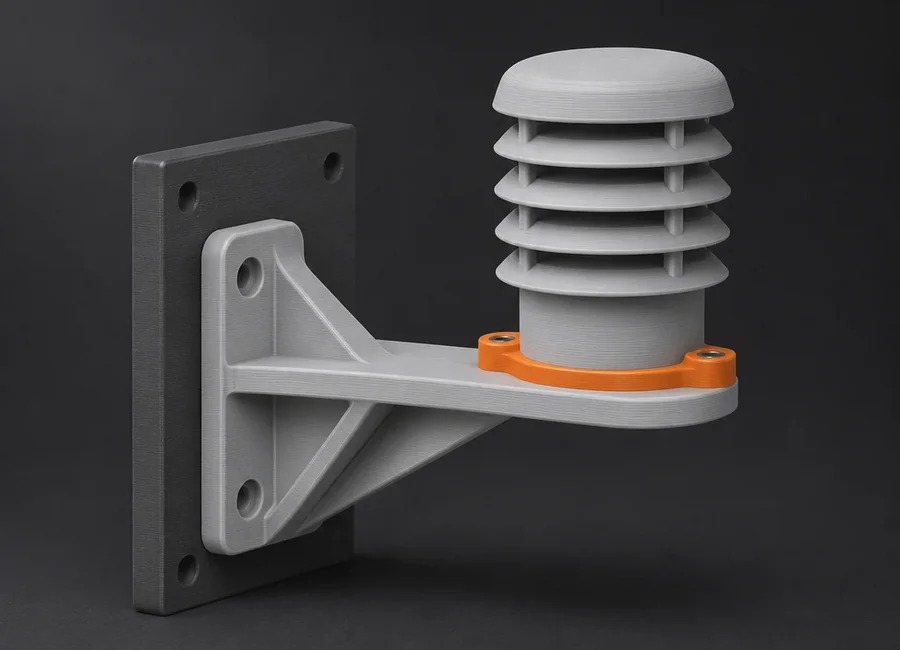
Position a sensor on outdoor equipment
A bracket could orient a sensor toward a defined measurement area. For a potential ASA version, available space, fastening and acceptable movement would be specified. The review would also consider whether the sensor bracket sits in full sunlight or is partly shaded by the surrounding equipment.
Possible application 2
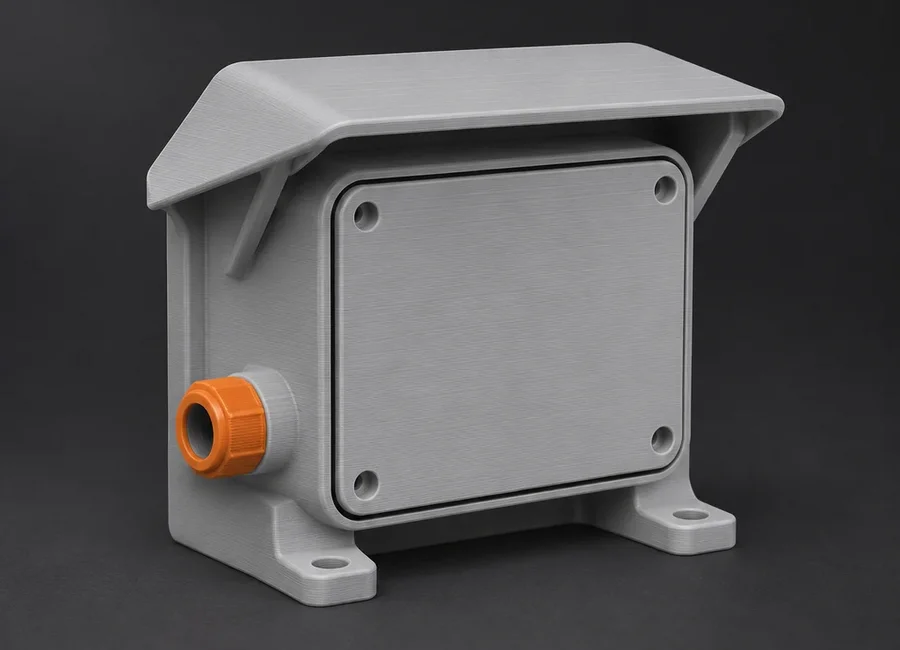
Shield a mounting area from direct weather
A small cover could shield an exposed mounting area from direct rainfall or sun. Its shape would have to fit the existing installation. Drainage, maintenance access and fastening locations would matter alongside ASA’s general suitability as an outdoor material.
Compare the function
ASA or ABS when the location changes?
ABS may be considered for a similar housing inside a workshop. If that version will remain outside for extended periods, ASA is the natural comparison because of its better UV and weather resistance. This still does not determine sealing or fastening strength, since those also depend on the design.
Design a housing for an outdoor experiment
An experimental setup could require a custom shell with internal mounts and cable openings. An ASA prototype could first establish fit and access. Whether the finished version provides the required protection would then depend on seams, cable entries and its actual installation orientation.
Design · Material grade · Service
Assess ASA for the actual part
What matters when choosing it
ASA is a natural candidate when UV resistance matters more than the simplest possible production process. Solar heating, temperature changes and loads at mounting points must also be considered. Describe the eventual component location as specifically as possible. Sheltered mounting under a roof differs from an exposed position in direct sunlight.
Limits and alternatives
An ASA print is not automatically watertight or a tested protective enclosure. Seams, seals and cable entries must suit the task. Warping and dimensional accuracy remain manufacturing considerations, especially for larger parts. For a cover, establish whether water merely needs to drain away or a defined seal is required. Those are different tasks and can lead to different solutions.
Sources
Manufacturer information
Manufacturer data refer to specific grades and test conditions. The application images on this page are AI-generated illustrations.
Your next step
Discuss your ASA application
For an ASA enquiry, provide photographs of the location, required dimensions and details of sun, weather and mounting. Explain the purpose of openings and any existing sealing interfaces.