
FDM material · Applications · Alternatives
Glass-fiber-reinforced filaments in 3D printing
GF means glass-fiber reinforcement, rather than a separate plastic. PA6-GF, for example, combines polyamide and glass fibers; ABS-GF has a different base. Heat, moisture and toughness information cannot simply be transferred between all GF grades. An enquiry should therefore identify the complete material name wherever possible. The examples describe tasks for which an appropriate glass-fiber-reinforced grade could be assessed.
Possible application 1
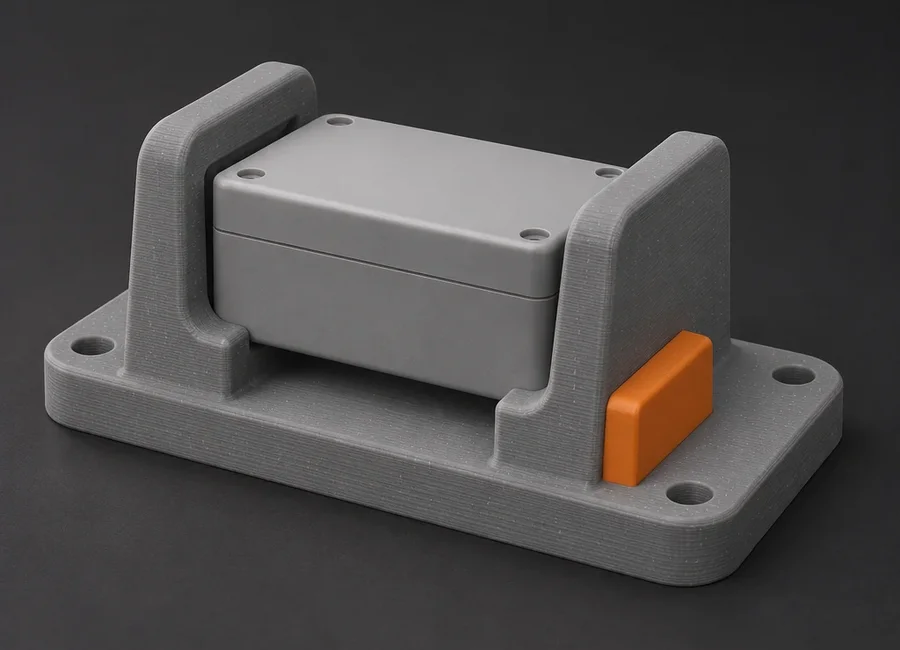
Review an assembly nest for limited deflection
A nest could hold an assembly during recurring operations. PA6-GF would be one grade to consider if the nest should yield little under the intended forces. Contact surfaces, fastening and ambient humidity would be recorded before a trial, so the assessment represents the eventual use meaningfully.
Possible application 2
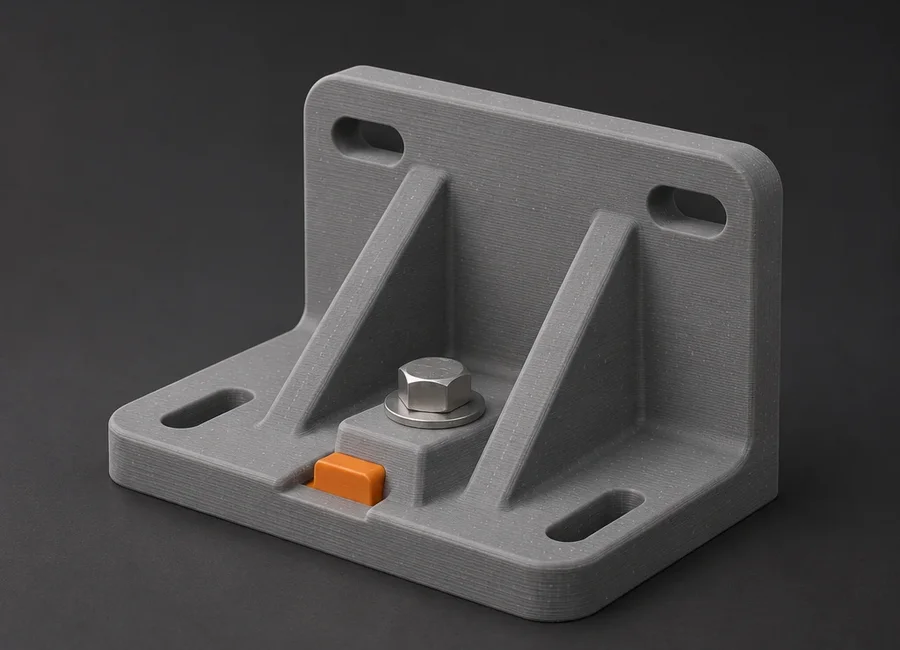
Coordinate a technical bracket design
A bracket could carry a device in a defined position. A suitable GF grade would need consideration alongside walls, supports and load distribution. It would be particularly important to distinguish steady loading from repeated impacts during insertion and operation of the device.
Compare the function
PA6-GF or unfilled PA for a latch?
If a latch must deflect substantially during opening, extra stiffness is not automatically useful. Unfilled PA and PA6-GF would therefore be compared using the desired movement and repeated operation. A rigid nest, by contrast, may benefit from limited deflection. The task determines whether fiber reinforcement helps or makes the design less appropriate.
Trial the shape of a larger housing component
A housing component could benefit from the changed dimensional behavior of a glass-fiber-reinforced grade. A possible prototype would first require an agreed base polymer, geometry and critical mating surfaces. It could then establish whether this combination actually suits the task compared with an unfilled version.
Design · Material grade · Service
Assess GF filaments for the actual part
What matters when choosing it
Fibers can improve stiffness and dimensional stability. The base polymer and the finished part’s behavior in dry or humid conditions remain decisive. For material selection, distinguish required stiffness from needed toughness. Descriptions such as robust or high strength do not replace a defined requirement.
Limits and alternatives
Greater stiffness does not automatically mean greater impact toughness or stronger layer bonds. Repeated bending and snap features require separate assessment. Abrasive fibers also influence the choice of printing tools. The appearance of a surface is not a dependable material identification method. For a sample-based replacement, existing material information or documentation of the original component can help.
Sources
Manufacturer information
Manufacturer data refer to specific grades and test conditions. The application images on this page are AI-generated illustrations.
Your next step
Discuss your GF filaments application
Provide the full material designation if known, and explain loading, movement and the environment. Drawings, sample photographs and required mating dimensions support selection of a suitable GF grade.