
FDM material · Applications · Alternatives
PA and nylon 3D printing: movement and wear
PA means polyamide; nylon is a common name for this family. Unfilled PA grades can be tough, wear-resistant and compliant in thin sections. PA6, PA12 and other formulations do not behave identically. The general name is therefore insufficient for a dependable choice. In the examples below, geometry, the movement involved and the actual PA grade would need to be considered together.
Possible application 1
Trial a sliding element in a slow guide
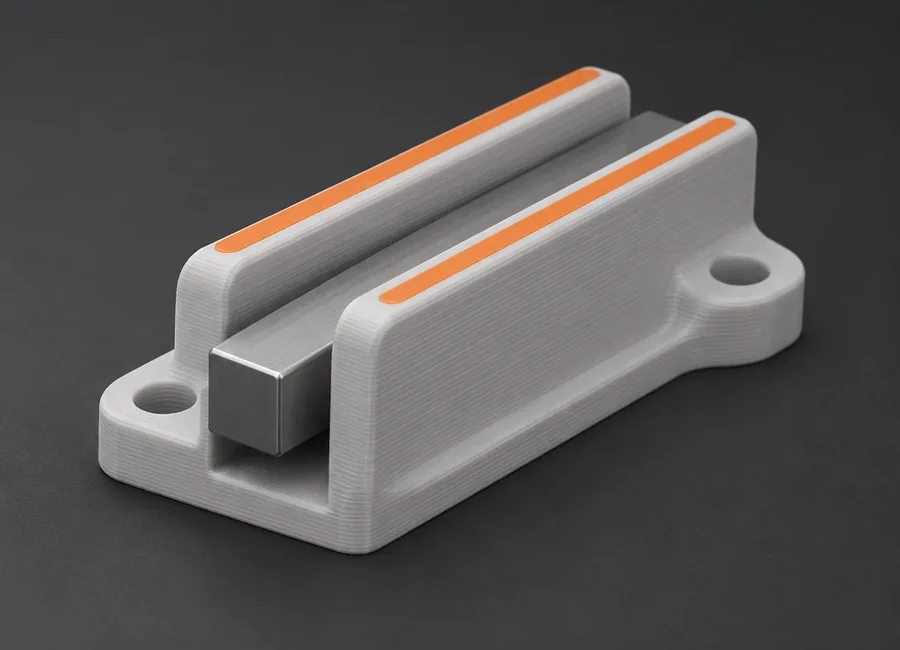
A sliding element matching an existing contour could accompany a slowly moving guide. A PA prototype could be examined for its interaction with the mating material and any change in clearance during use. Contamination and the lubrication actually present would also form part of the trial.
Possible application 2
Operate a snap closure repeatedly
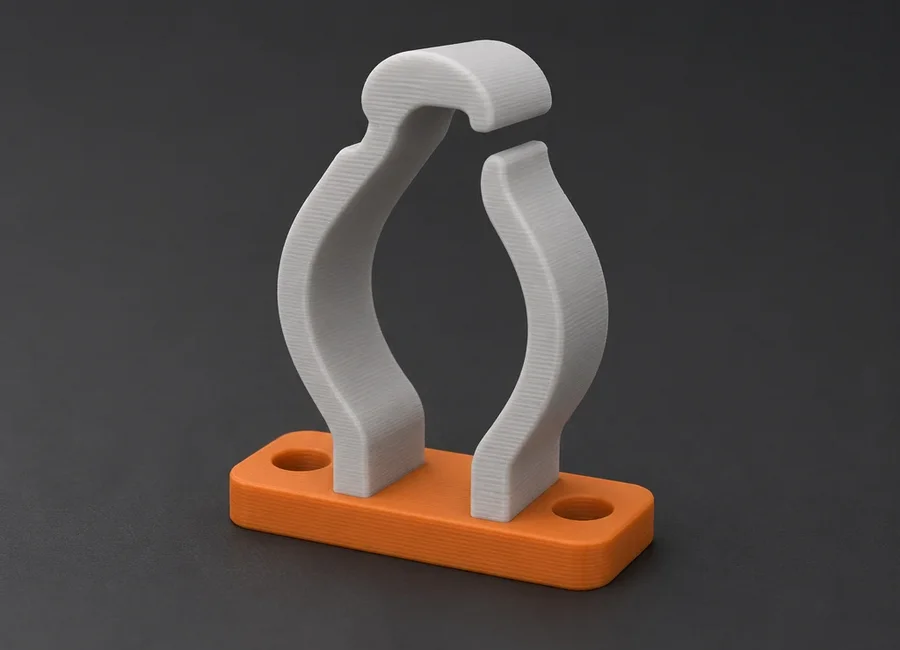
A housing lid could close through a deflecting latch. For a possible PA version, a prototype could establish the required movement, operating force and recovery. Latch geometry and print orientation would matter alongside the properties of the chosen material.
Compare the function
Unfilled PA or PAHT-CF?
A region intended to deflect has different needs from a stiff fixture. Unfilled PA therefore provides a different starting point from carbon-reinforced nylon. PAHT-CF is more likely to be assessed where limited deflection matters. A snap closure cannot necessarily be improved by simply changing to stiffer filament: the desired movement determines which approach makes sense.
Adapt a spacer washer to an assembly
A custom washer could establish a gap in an assembly while allowing limited compliance. Before selecting PA, it would be necessary to distinguish loading during assembly from loading that remains for an extended time. Critical mating dimensions would be specified for the eventual environment.
Design · Material grade · Service
Assess PA / Nylon for the actual part
What matters when choosing it
PA is worth considering when movement, rubbing contact or repeated deformation matters. The actual grade and a trial under intended conditions are often more useful than the general name nylon. Alongside movement, the review records the mating material, contact surfaces and relevant ambient humidity. Wear patterns on an old component can also be useful.
Limits and alternatives
Polyamides absorb moisture, which can change dimensions, stiffness and service behavior. Tight fits must account for the eventual moisture condition. Keeping filament dry while printing does not by itself guarantee permanently unchanged dimensions. A prototype measured dry may fit differently after moisture exposure. For recurring production, the condition used for dimensional inspection must be defined and traceable.
Sources
Manufacturer information
Manufacturer data refer to specific grades and test conditions. The application images on this page are AI-generated illustrations.
Your next step
Discuss your PA / Nylon application
Explain the movement, mating material and wear location. Photographs of the old component, required clearance and environmental information help define an appropriate PA grade and a useful trial.