
FDM material · Applications · Alternatives
PAHT-CF 3D printing: stiff fixtures and brackets
PAHT-CF combines a nylon base with short carbon fibers. It is worth considering when a fixture must remain stiff and heat and moisture also influence material selection. Carbon fibers do not make it an unrestricted replacement for metal. A useful application description therefore goes beyond asking for a strong part. It identifies acceptable movement, locating surfaces and the points where forces actually enter the component.
Possible application 1
Position an assembly during repeated operations
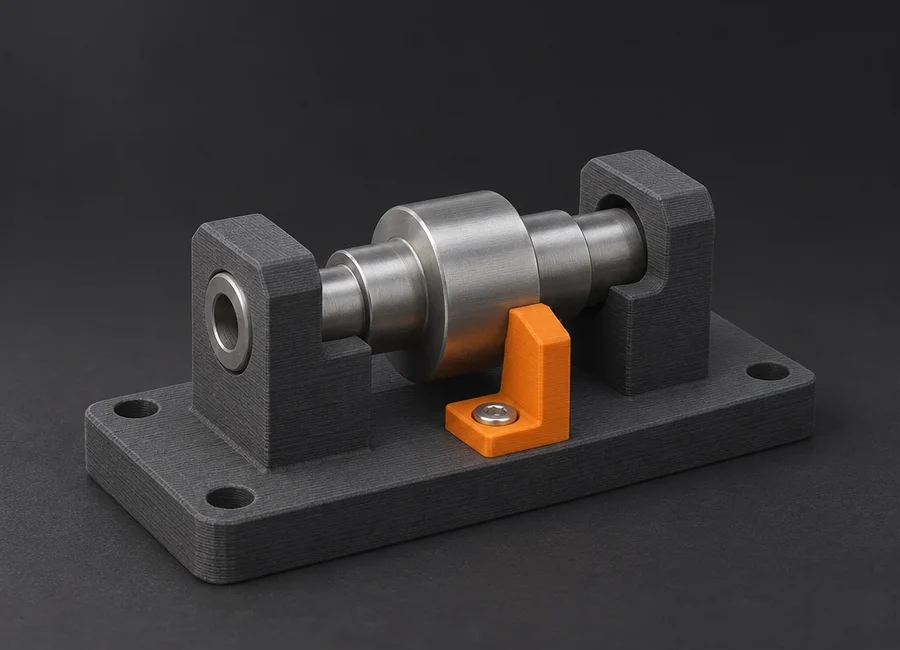
An assembly nest could support a component on the same surfaces during repeated operations. A possible PAHT-CF version would require consideration of location, working access and insertion forces. A prototype could reveal whether the nest remains sufficiently steady or whether individual supports need a different arrangement.
Possible application 2
Hold a sensor near a warm assembly
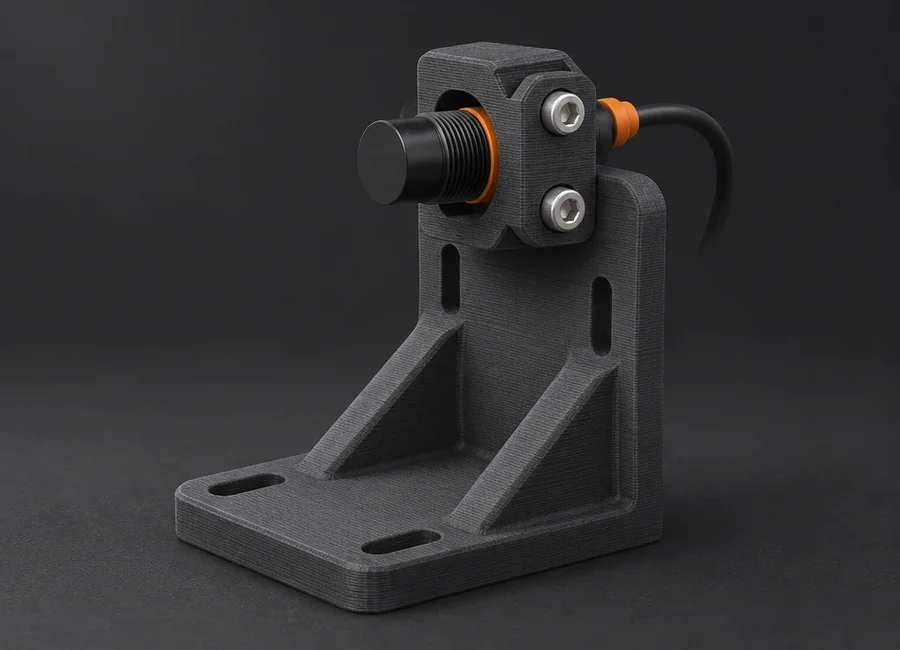
A custom bracket could position a sensor near a warm assembly. Before selecting PAHT-CF, the bracket temperature, fastening and acceptable position change would be recorded. A trial could then assess the chosen combination of geometry and material under the agreed conditions.
Compare the function
PAHT-CF or unfilled nylon?
Limited deflection is often desirable in an assembly nest. A latch intended to flex during opening has a different purpose. PAHT-CF and unfilled PA are therefore not merely stronger and weaker versions of the same component. First establish whether the part must remain stiff or yield in a controlled way; that determines the meaningful comparison.
Prepare a technical small batch
A functional prototype could trial a planned part nest before recurring orders. Fit, operation and critical dimensions could be checked against an agreed data revision. Only after this review would the features to be repeatedly manufactured and inspected in a potential batch be defined.
Design · Material grade · Service
Assess PAHT-CF for the actual part
What matters when choosing it
Limited deflection, fastening design and contact forces matter in selection. Bambu reports lower moisture uptake than conventional PA-CF; nevertheless, the filament and process still require dry conditions. A drawing should identify effective contact surfaces and load direction as well as outside dimensions. Positioning applications also need an acceptable limit on movement.
Limits and alternatives
Print orientation remains important: behavior between layers can differ from behavior within a layer. Sharp notches, concentrated screw forces or untested impact loads can undermine the benefit of a stiff material. Fiber reinforcement does not automatically fix poor load paths. The distance between fastenings and loads can matter as much to the outcome as the chosen material.
Sources
Manufacturer information
Manufacturer data refer to specific grades and test conditions. The application images on this page are AI-generated illustrations.
Your next step
Discuss your PAHT-CF application
For PAHT-CF, state the function, contact areas, fastenings and possible heating. Include critical dimensions and explain how much movement under load the nest may tolerate.