
FDM material · Applications · Alternatives
PC 3D printing: heat and mechanical demands
Polycarbonate is an engineering plastic worth considering where heat and mechanical demands occur together. Whether PC is appropriate depends on the filament formulation and the structure of the printed part. A close look at the installation location helps with this decision. A part near a heat source, a frequently handled housing and a firmly bolted bracket can have very different requirements despite similar overall dimensions.
Possible application 1
Assess a cover for a warmer location
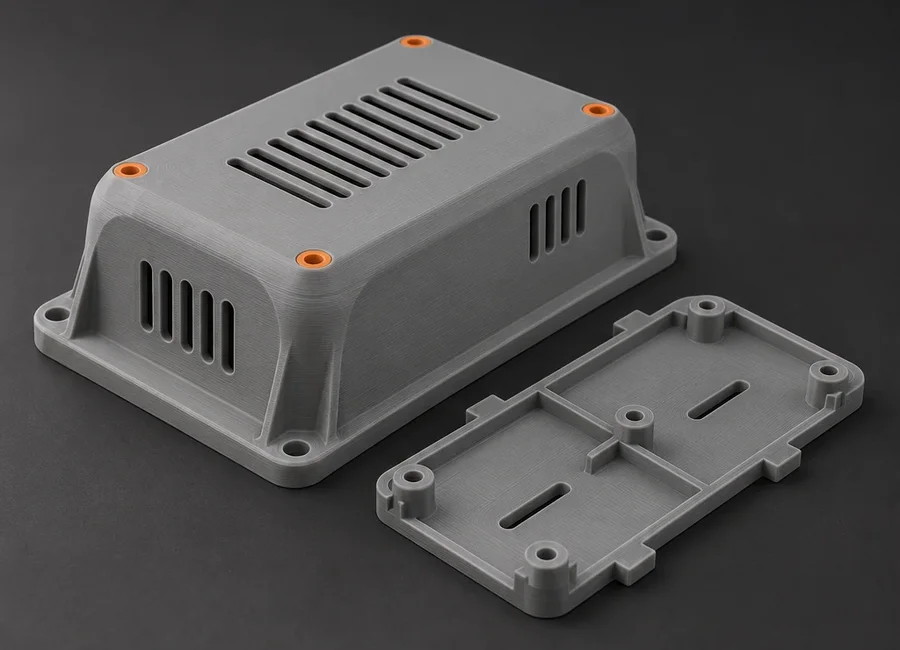
A device cover could be installed near a warm assembly. For a potential PC version, the actual component temperature and exposure duration would need to be known. A prototype could first establish space, fastening and maintenance access before service under the specified conditions is evaluated.
Possible application 2
Hold a sensor on a test setup
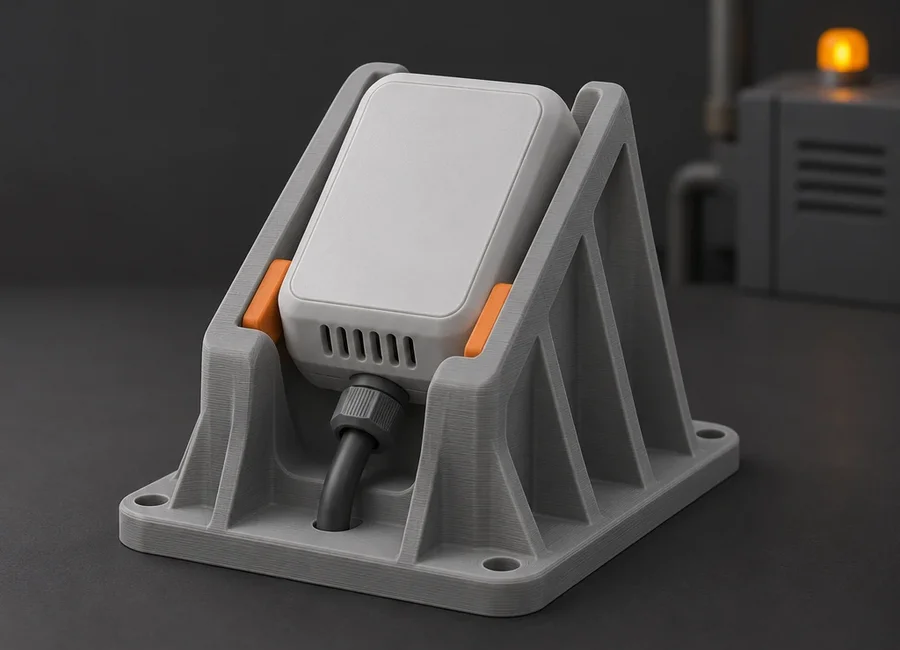
A technical bracket could position a sensor on a frequently used test setup. Installation forces, accidental contact and the desired positional stability could be considered together. PC would be one possible material where these demands and the environment require more than a simple fit prototype.
Compare the function
PC or PETG for a device housing?
A moderately demanding housing can first be considered in PETG. Where actual heat and mechanical requirements go further, PC becomes another comparison option. A supposedly higher-grade material is not a reason by itself: a more demanding manufacturing process adds little if a simpler, suitably designed version already meets the task.
Trial a frequently handled housing
A portable functional prototype could reveal how a housing is used during repeated picking up and setting down. A PC version would require particular consideration of screws, edges and contact points. The trial might also reveal that an apparent material weakness actually comes from poor geometry or fastening.
Design · Material grade · Service
Assess PC / Polycarbonate for the actual part
What matters when choosing it
PC may be a comparison option when PLA or PETG does not cover the requirements. Rather than relying on a single temperature figure, we consider load duration, screw joints, wall thickness and acceptable deformation. Fastenings should not be decided only after choosing the material. Screw forces and supports influence how material properties translate into the component.
Limits and alternatives
Large geometries can be challenging because of warping. Exposure to cleaners, oils or other substances needs a grade-specific assessment. The material name alone provides no approval as a safety cover or fire-protection component and no guaranteed service life. The comparison therefore records mounting condition and the substances involved. Its conclusions concern the chosen configuration rather than automatically extending to every similar geometry.
Sources
Manufacturer information
Manufacturer data refer to specific grades and test conditions. The application images on this page are AI-generated illustrations.
Your next step
Discuss your PC / Polycarbonate application
Send CAD data, installation details and information on heat sources, exposure duration and fastening. Identify any cleaners or other substances that contact the component during use.