
FDM material · Applications · Alternatives
TPU 95A HF 3D printing: bumpers, protection and inserts
TPU is an elastic plastic. The 95A designation describes material hardness on the Shore A scale, rather than how soft a finished part will feel. A solid section behaves differently from a thin wall or an open internal structure. Selection therefore begins with the intended movement: how far should the part yield, where is it held, and how should it recover after the load is removed?
Possible application 1
Cushion a light stop
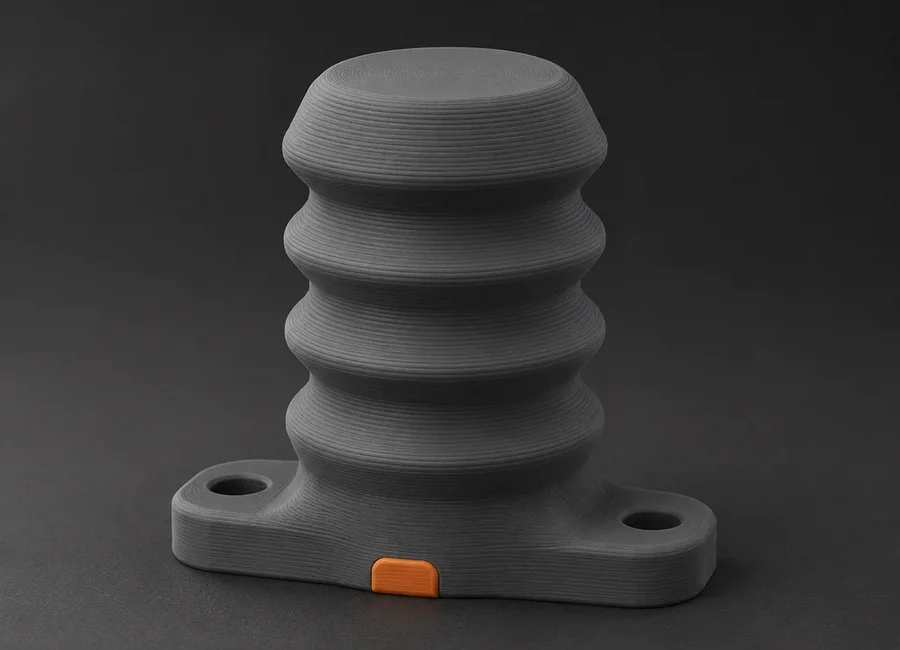
A small bumper could cushion light contact on a fixture. A possible TPU version would be designed around movement, contact area and fastening. A prototype could establish whether it yields sufficiently or whether its geometry needs adjustment to produce the intended response.
Possible application 2
Cover an edge during transport
A fitted protective cap could shield a delicate edge during movement within a workplace. It would have to be installed and removed without slipping unintentionally. A TPU prototype could help assess fit, grip areas and clearance from the protected surface together.
Compare the function
TPU or a rigid PETG body?
If the entire nest must retain its position, a wholly flexible part may be the wrong approach. A rigid body and a fitted TPU insert can separate the tasks of keeping shape and providing compliant contact. Desired movement, contact areas and assembly operations determine whether this arrangement makes sense, rather than hardness alone.
Hold a workpiece with a compliant insert
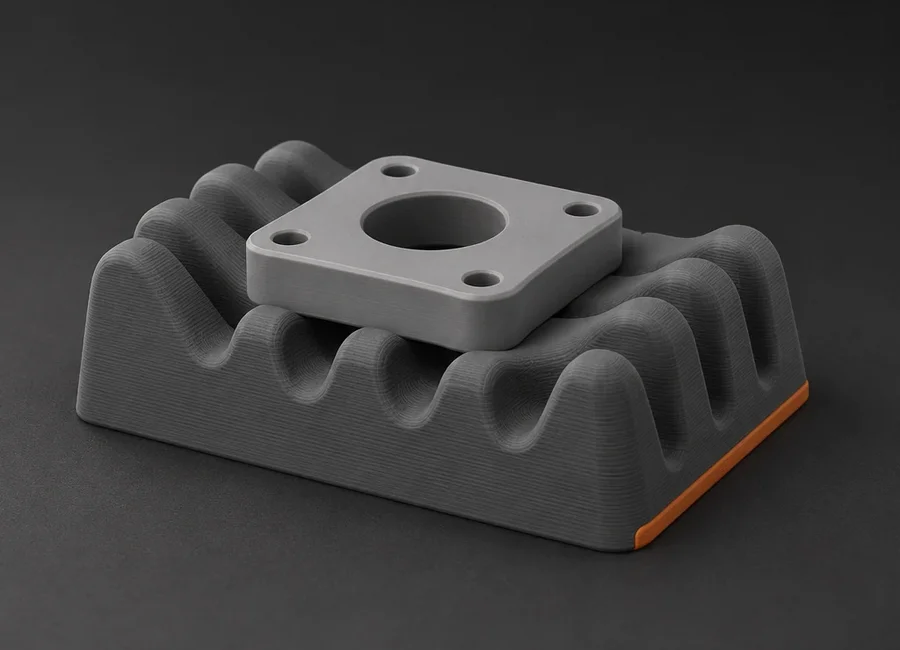
A nest could receive a separate TPU insert so the contact area can yield while the main body retains its shape. Insertion, removal and workpiece location could be examined in a trial. The softer contact must not unintentionally change the positioning that the operation requires.
Design · Material grade · Service
Assess TPU 95A HF for the actual part
What matters when choosing it
TPU may suit tasks where controlled compliance is wanted. Material hardness, walls and internal structure therefore need to be matched to the desired movement. An existing soft sample can help when the desired response is difficult to describe. State whether deformation occurs occasionally or remains on the part continuously.
Limits and alternatives
TPU is usually unsuitable for rigid, dimensionally stable brackets. A flexible printed ring is not automatically a suitable pressure seal. Repeated deformation, rubbing, temperature and elastic recovery must be assessed for its specific use. Fastening can also change the response. A tightly clamped region behaves differently from a freely moving wall made from the same material.
Sources
Manufacturer information
Manufacturer data refer to specific grades and test conditions. The application images on this page are AI-generated illustrations.
Your next step
Discuss your TPU 95A HF application
Describe the desired movement, contact surface and fastening. Photographs, a sketch and details of repeated or sustained deformation help define a useful TPU prototype.